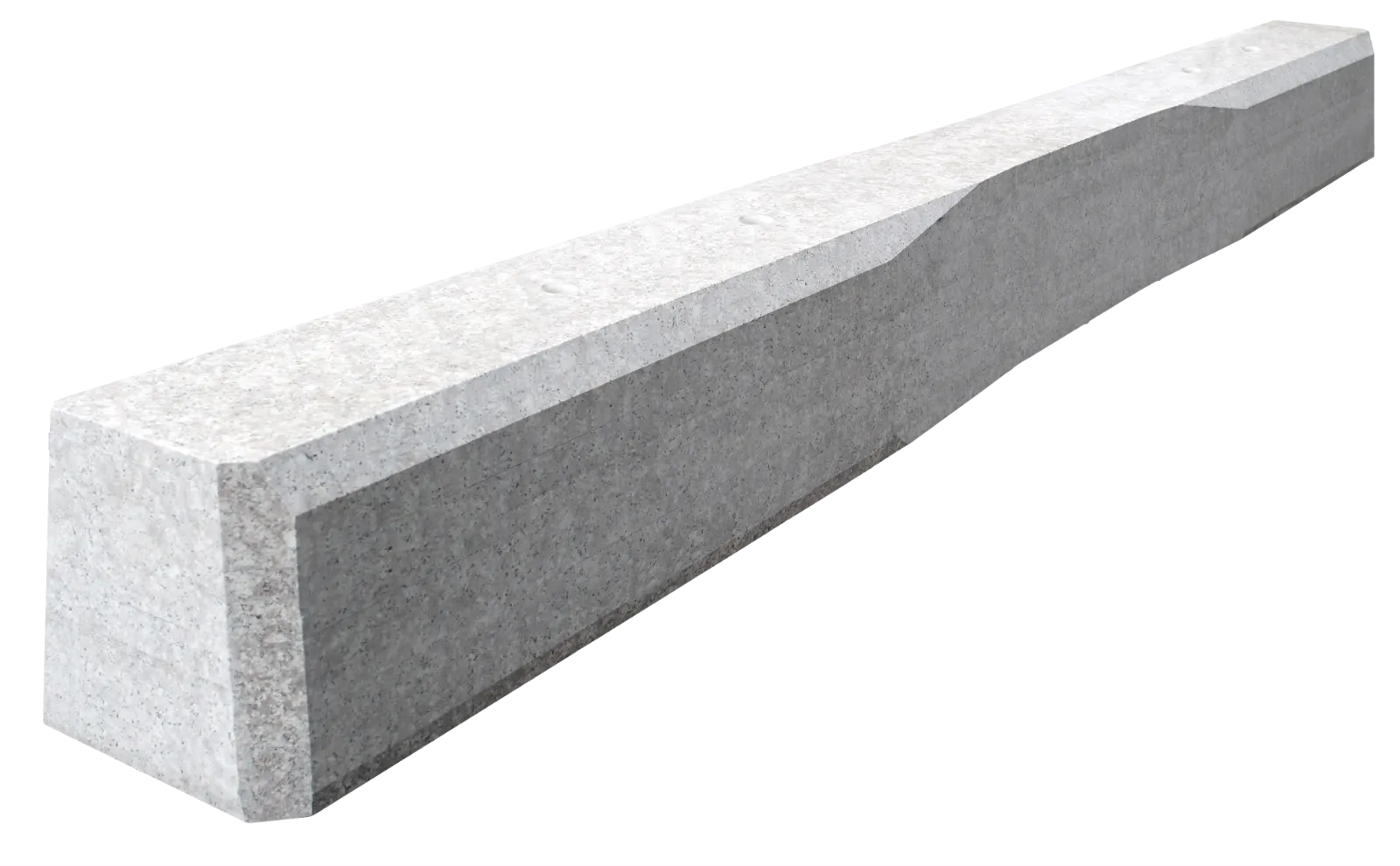
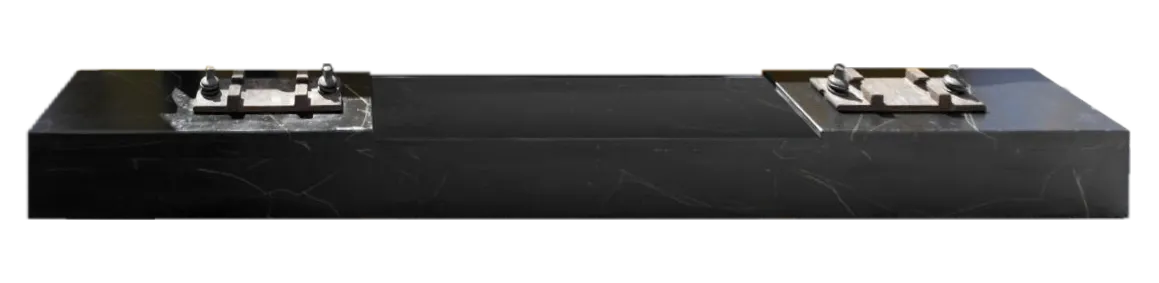
Consisting of 6 layers of Chinese Granite made for a load of 176kN at rail support.
Depending on the technical design, the weight is between 250 kg and 470 kg and can be reduced by optimizing the specification as required.
The above sleeper is constructed in layers and utilizes pre-stressed carbon fibre and glass fibre for reinforcement against breakage and was shown for the first time in 2017 at the trade fair in Münster. The layered design is patent pending and the patent has already been granted in major industrialized countries.
This technology is being presented to sleeper manufacturers and includes a transitional CFS rebar/Concrete hybrid, to ease the pain as the World moves away from Concrete.
The sleeper meets the requirements of Deutsche Bahn on B60 and B70 sleepers from a load bearing point of view. The load capacity is comparable to that of concrete sleepers. There are 2 significant benefits – 1) a useful working life of at least 100 years (natural raw material) and 2) During this time, the sleeper is operated 100% crack-free.
Also, The CO2 footprint is 25% less than that of an equivalent steel-reinforced concrete sleeper.
With this layered structure, a degree of flexibility is introduced to adapt it to different load cases.
Our ecological future lies in the use of carbon fibre, which can now be produced from CO2. This feature cannot be offered using traditional materials..
These “Smart Materials” will, in future, be produced from CO2 and, in combination with renewable energy, be able to stop climate change.
Alternative stone used here
Introduction
Mineral materials such as Granite and Basalt, when combined intelligently, with carbon fibre, can be used as a construction material in place of steel, aluminium and concrete.
TechnoCarbon is defining the future paradigm in construction and building materials. Here we show how this strong, new and lightweight material, equipped with the utmost green credentials, could be introduced into the ‘New Railway’ of the UK.
General overview
Pre-loading of a layer of porous hard rock, like granite, is made under controlled conditions. Then, whilst it is still under pre-load, it is ‘sealed’ with a layer of carbon fibre. The impossible becomes possible and a degree of flexibility is observed in Granite without compromising its impact resistance! Plus…the properties of controlling effective vibration damping and thermal expansion are introduced: the ideal material concept for Railway Sleepers.
Comparison with concrete sleepers
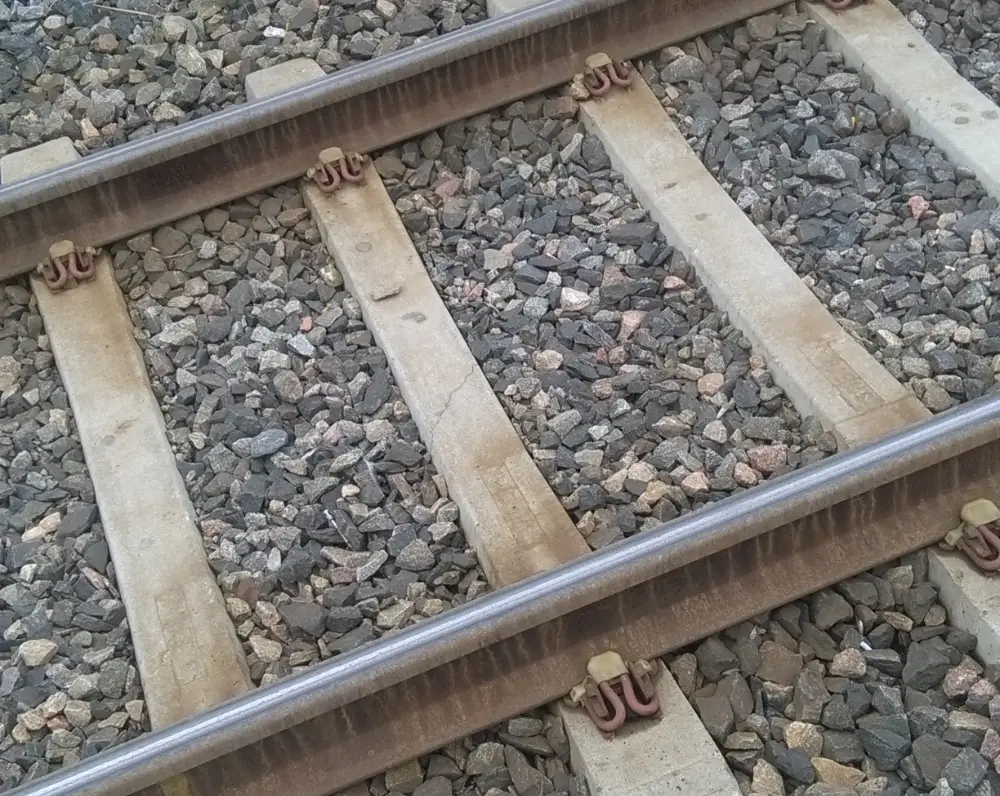
Concrete sleepers have served the railway industry for over 120 years, but the time for a more durable material has come
Strength
CarbonFibreStone impact and pressure strength is twice that of concrete and can be designed into or out of each application.
Frost resistance
The hairline cracks of concrete that allow the ingress of water (and consequential ice damage) are now gone since CarbonFibreStone gives absolute frost resistance.
Consequently, these two points result in a much higher durability than concrete.
Bridge Construction
Aluminium
Aluminium weighs 2.699 g/cm³. Therefore, the density of aluminium is equal to 2,699 kg/m³ at 20°C (68°F or 293.15K) at standard atmospheric pressure.
Solid Granite
Solid granite weighs 2.691 g/cm³. Therefore, the density of granite is equal to 2,691 kg/m³.
Solid Basalt
Solid basalt weighs 3.011 gram per cm³. Therefore, the density of basalt is equal to 3,011 kg/m³.
It is obvious from comparing these weights, that the combination of Carbon Fibre and either granite or basalt (creating CarbonFibreStone), proves comparable with aluminium as a lightweight material, and therefore has the potential to replace environmentally problematic metals.
Thermal elongation (a problem for aluminium and concrete) can be designed into or out of each application.
Green credentials and benefits
Natural stone is more aesthetically pleasing to the eye than metal. Creative flair can be employed with these new materials as a benefit at no additional cost.